Kodak Photo Fabric Stick Ups Printprojects Software Download

Press is a procedure for mass reproducing text and images using a master form or template. The earliest non-newspaper products involving printing include cylinder seals and objects such every bit the Cyrus Cylinder and the Cylinders of Nabonidus. The primeval known class of printing as applied to newspaper was woodblock printing, which appeared in Cathay before 220 Advert for cloth press. All the same, it would not be applied to paper until the seventh century.[1] Afterward developments in printing technology include the movable blazon invented by Bi Sheng effectually 1040 AD[2] and the printing press invented by Johannes Gutenberg in the 15th century. The technology of printing played a central function in the development of the Renaissance and the Scientific Revolution and laid the fabric basis for the modern knowledge-based economy and the spread of learning to the masses.[3]
History [edit]
Woodblock printing [edit]
Woodblock press is a technique for printing text, images or patterns that was used widely throughout East Asia. It originated in China in artifact as a method of press on textiles and afterwards on paper. As a method of printing on material, the earliest surviving examples from Mainland china date to before 220 A.D.
In Eastern asia [edit]

The earliest surviving woodblock printed fragments are from China. They are of silk printed with flowers in iii colours from the Han Dynasty (earlier 220 A.D.). The earliest examples of woodblock printing on newspaper appear in the mid-seventh century in China.
By the 9th century, press on paper had taken off, and the first extant complete printed book containing its date is the Diamond Sutra (British Library) of 868.[4] By the tenth century, 400,000 copies of some sutras and pictures were printed, and the Confucian classics were in print. A skilled printer could print upwardly to ii,000 double-page sheets per 24-hour interval.[5]
Printing spread early to Korea and Japan, which likewise used Chinese logograms, simply the technique was also used in Turpan and Vietnam using a number of other scripts. This technique then spread to Persia and Russia.[half dozen] This technique was transmitted to Europe by effectually 1400 and was used on paper for one-time master prints and playing cards.[vii]
In Middle Eastward [edit]
Block printing, called tarsh in Arabic, developed in Arabic Egypt during the ninth and tenth centuries, more often than not for prayers and amulets. At that place is some prove to propose that these impress blocks fabricated from non-forest materials, possibly tin, lead, or clay. The techniques employed are uncertain. Block printing later went out of use in Islamic Timurid Renaissance.[viii] The printing technique in Arab republic of egypt was embraced reproducing texts on paper strips and supplying them in different copies to come across the demand.[9] [x]
In Europe [edit]
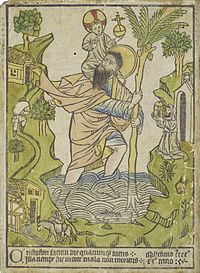
Block printing first came to Europe as a method for printing on textile, where it was mutual past 1300. Images printed on cloth for religious purposes could be quite large and elaborate. When newspaper became relatively hands available, effectually 1400, the technique transferred very quickly to small woodcut religious images and playing cards printed on paper. These prints produced in very big numbers from about 1425 onward.
Around the mid-fifteenth-century, cake-books, woodcut books with both text and images, usually carved in the same cake, emerged every bit a cheaper alternative to manuscripts and books printed with movable blazon. These were all short heavily illustrated works, the bestsellers of the day, repeated in many different block-book versions: the Ars moriendi and the Biblia pauperum were the most common. At that place is still some controversy among scholars equally to whether their introduction preceded or, the majority view, followed the introduction of movable blazon, with the range of estimated dates being betwixt well-nigh 1440 and 1460.[11]
Movable-type printing [edit]
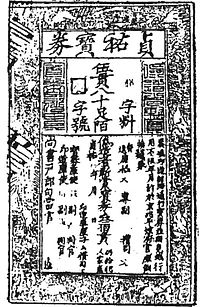
Copperplate of 1215–1216 5000 cash paper money with ten bronze movable types

Movable type is the arrangement of printing and typography using movable pieces of metal type, fabricated past casting from matrices struck by letterpunches. Movable blazon allowed for much more than flexible processes than hand copying or block printing.
Around 1040, the first known movable blazon system was created in China by Bi Sheng out of porcelain.[2] Bi Sheng used clay type, which broke hands, but Wang Zhen by 1298 had carved a more durable type from wood. He as well developed a complex arrangement of revolving tables and number-clan with written Chinese characters that made typesetting and printing more efficient. Withal, the master method in use at that place remained woodblock printing (xylography), which "proved to be cheaper and more efficient for printing Chinese, with its thousands of characters".[12]
Copper movable type printing originated in China at the starting time of the twelfth century. It was used in large-scale printing of paper money issued past the Northern Song dynasty. Movable type spread to Korea during the Goryeo dynasty.
Effectually 1230, Koreans invented a metal type movable printing using bronze. The Jikji, published in 1377, is the primeval known metal printed volume. Type-casting was used, adapted from the method of casting coins. The graphic symbol was cut in beech wood, which was then pressed into a soft clay to form a mould, and bronze poured into the mould, and finally the type was polished.[13] The Korean form of metal movable type was described past the French scholar Henri-Jean Martin as "extremely similar to Gutenberg'southward".[14]
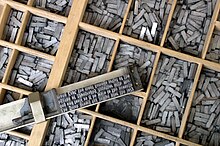
A instance of cast metallic blazon pieces and typeset affair in a composing stick
The printing press [edit]
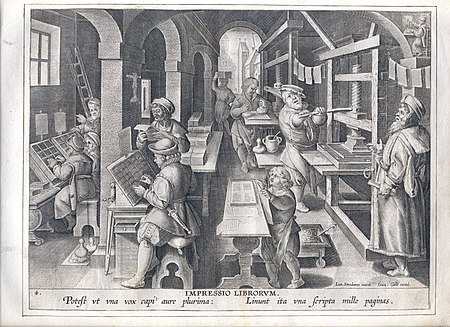
Around 1450, Johannes Gutenberg introduced the first movable type printing arrangement in Europe. He advanced innovations in casting blazon based on a matrix and hand mould, adaptations to the screw-press, the use of an oil-based ink, and the creation of a softer and more absorbent newspaper.[15] Gutenberg was the outset to create his type pieces from an alloy of lead, tin, antimony, copper and bismuth – the aforementioned components nonetheless used today.[16] Johannes Gutenberg started work on his printing press around 1436, in partnership with Andreas Dritzehen – whom he had previously instructed in gem-cutting – and Andreas Heilmann, the possessor of a newspaper mill.[17]
Compared to woodblock printing, movable type page setting and printing using a printing was faster and more durable. Also, the metal blazon pieces were sturdier and the lettering more than compatible, leading to typography and fonts. The loftier quality and relatively low toll of the Gutenberg Bible (1455) established the superiority of movable type for Western languages. The printing printing rapidly spread across Europe, leading up to the Renaissance, and afterward all effectually the world.
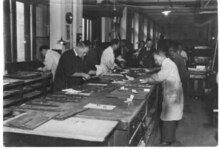
Folio-setting room – c. 1920
Gutenberg'south innovations in movable type press take been called the most important invention of the second millennium.[18]
Rotary press printing [edit]
The rotary press press was invented by Richard March Hoe in 1843. It uses impressions curved effectually a cylinder to print on long continuous rolls of paper or other substrates. Rotary drum printing was later significantly improved by William Bullock. At that place are multiple types of rotary printing press technologies that are nonetheless used today: sheetfed offset, rotogravure, and flexographic press.
Printing capacity [edit]
The table lists the maximum number of pages which various press designs could print per hour.
| Hand-operated presses | Steam-powered presses | |||||
|---|---|---|---|---|---|---|
| Gutenberg-style c. 1600 | Stanhope press c. 1800 | Koenig press 1812 | Koenig press 1813 | Koenig press 1814 | Koenig press 1818 | |
| Impressions per 60 minutes | 200 [19] | 480 [20] | 800 [21] | one,100 [22] | 2,000 [23] | 2,400 [23] |
Conventional printing engineering [edit]
All printing process are concerned with two kinds of areas on the final output:
- Image expanse (press areas)
- Non-image area (non-press areas)
Subsequently the data has been prepared for production (the prepress step), each printing process has definitive means of separating the image from the not-paradigm areas.
Conventional printing has four types of process:
- Planographics, in which the printing and non-printing areas are on the aforementioned plane surface and the departure between them is maintained chemically or past physical properties, the examples are: offset lithography, collotype, and screenless printing.
- Relief, in which the printing areas are on a airplane surface and the not printing areas are below the surface, examples: flexography and letterpress.
- Intaglio, in which the non-printing areas are on a airplane surface and the printing area are etched or engraved below the surface, examples: steel die engraving, gravure, etching, collagraph.
- Porous or Stencil, in which the printing areas are on fine mesh screens through which ink can penetrate, and the not-printing areas are a stencil over the screen to block the flow of ink in those areas, examples: screen printing, stencil duplicator, risograph.
Letterpress [edit]
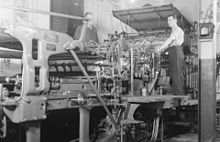
Miehle press printing Le Samedi periodical. Montreal, 1939.
Letterpress printing is a technique of relief printing. A worker composes and locks movable blazon into the bed of a press, inks information technology, and presses paper against information technology to transfer the ink from the type which creates an impression on the paper. At that place is different paper for unlike works the quality of newspaper shows unlike ink to apply.
Letterpress press was the normal form of printing text from its invention by Johannes Gutenberg in the mid-15th century and remained in wide use for books and other uses until the 2d half of the 20th century, when offset printing was developed. More recently, letterpress printing has seen a revival in an artisanal form.
Offset [edit]
Outset printing is a widely used mod printing process. This engineering science is best described as when a positive (right-reading) image on a press plate is inked and transferred (or "offset") from the plate to a condom blanket. The blanket paradigm becomes a mirror epitome of the plate epitome. An commencement transfer moves the image to a press substrate (typically newspaper), making the image right-reading again. Beginning printing utilizes a lithographic process which is based on the repulsion of oil and h2o. The start process employs a flat (planographic) paradigm carrier (plate) which is mounted on a press cylinder. The epitome to be printed obtains ink from ink rollers, while the non-printing area attracts an (acidic) film of water, keeping the non-paradigm areas ink-gratuitous. Almost offset presses utilise three cylinders: Plate, blanket, impression. Currently, well-nigh books and newspapers are printed using offset lithography.
Gravure [edit]
Gravure press is an intaglio printing technique, where the epitome beingness printed is made up of modest depressions in the surface of the printing plate. The cells are filled with ink, and the excess is scraped off the surface with a doctor blade. And then a condom-covered roller presses paper onto the surface of the plate and into contact with the ink in the cells. The press cylinders are ordinarily fabricated from copper plated steel, which is subsequently chromed, and may be produced by diamond engraving; etching, or laser ablation.
Gravure press is used for long, loftier-quality impress runs such every bit magazines, mail-order catalogues, packaging and printing onto fabric and wallpaper. It is too used for printing stamp stamps and decorative plastic laminates, such as kitchen worktops.
Flexography [edit]
Flexography is a type of relief printing. The relief plates are typically made from photopolymers. The process is used for flexible packaging, corrugated board, labels, newspapers and more. In this market it competes with gravure printing by holding 80% of the market in The states, 50% in Europe but only 20% in Asia.[24]
Other printing techniques [edit]
The other significant press techniques include:
- Dye-sublimation printer
- Inkjet, used typically to print a small number of books or packaging, and also to impress a variety of materials: from high quality papers simulating commencement printing, to floor tiles. Inkjet is too used to employ mailing addresses to straight mail pieces
- Laser printing (toner printing) mainly used in offices and for transactional printing (bills, bank documents). Laser printing is commonly used by direct mail companies to create variable data letters or coupons.
- Pad press, popular for its ability to print on circuitous three-dimensional surfaces
- Relief print, mainly used for catalogues
- Screen-printing for a multifariousness of applications ranging from T-shirts to floor tiles, and on uneven surfaces
- Intaglio, used mainly for high value documents such equally currencies.
- Thermal printing, popular in the 1990s for fax printing. Used today for printing labels such equally airline baggage tags and individual price labels in supermarket cafeteria counters.
Impact of German language movable type printing printing [edit]
Quantitative aspects [edit]

European output of books printed by movable type from ca. 1450 to 1800[25]
Information technology is estimated that following the innovation of Gutenberg'south printing press, the European volume output rose from a few million to around 1 billion copies within a bridge of less than four centuries.[25]
Religious bear on [edit]
Samuel Hartlib, who was exiled in Britain and enthusiastic most social and cultural reforms, wrote in 1641 that "the art of printing volition and so spread knowledge that the common people, knowing their own rights and liberties, will not exist governed by manner of oppression".[26]

In the Muslim earth, press, specially in Arabic scripts, was strongly opposed throughout the early modernistic flow, partially due to the loftier artistic renown of the art of traditional calligraphy. Notwithstanding, printing in Hebrew or Armenian script was often permitted. Thus, the starting time movable blazon printing in the Ottoman Empire was in Hebrew in 1493, after which both religious and not-religious texts were able to be printed in Hebrew.[27] According to an majestic administrator to Istanbul in the middle of the sixteenth century, it was a sin for the Turks, particularly Turkish Muslims, to print religious books. In 1515, Sultan Selim I issued a decree nether which the practice of printing would be punishable by death. At the finish of the sixteenth century, Sultan Murad III permitted the sale of non-religious printed books in Arabic characters, still the majority were imported from Italian republic. Ibrahim Muteferrika established the get-go press for printing in Arabic in the Ottoman Empire, against opposition from the calligraphers and parts of the Ulama. Information technology operated until 1742, producing birthday seventeen works, all of which were concerned with non-religious, commonsensical matters. Printing did not become common in the Islamic earth until the 19th century.[28]
Hebrew linguistic communication printers were banned from printing guilds in some Germanic states; as a issue, Hebrew printing flourished in Italian republic, beginning in 1470 in Rome, then spreading to other cities including Bari, Pisa, Livorno, and Mantua. Local rulers had the authority to grant or revoke licenses to publish Hebrew books,[29] and many of those printed during this period carry the words 'con licenza de superiori' (indicating their printing having been officially licensed) on their title pages.
It was thought that the introduction of press 'would strengthen religion and enhance the power of monarchs.'[30] The bulk of books were of a religious nature, with the church and crown regulating the content. The consequences of press 'wrong' material were extreme. Meyrowitz[30] used the example of William Carter who in 1584 printed a pro-Catholic pamphlet in Protestant-dominated England. The consequence of his activity was hanging.
[edit]
Print gave a broader range of readers access to knowledge and enabled later generations to build directly on the intellectual achievements of earlier ones without the changes arising within verbal traditions. Print, according to Acton in his 1895 lecture On the Study of History, gave "assurance that the work of the Renaissance would last, that what was written would be accessible to all, that such an occultation of cognition and ideas as had depressed the Center Ages would never recur, that not an idea would be lost".[26]
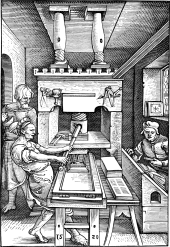
Bookprinting in the 16th century
Print was instrumental in changing the social nature of reading.
Elizabeth Eisenstein identifies ii long-term effects of the invention of printing. She claims that impress created a sustained and compatible reference for knowledge and allowed comparisons of incompatible views.[31]
Asa Briggs and Peter Shush identify v kinds of reading that adult in relation to the introduction of impress:
- Critical reading: Because texts finally became attainable to the full general population, critical reading emerged every bit people were able to form their ain opinions on texts.
- Dangerous reading: Reading was seen as a unsafe pursuit because information technology was considered rebellious and unsociable, peculiarly in the case of women, considering reading could stir up dangerous emotions such as love, and if women could read, they could read dearest notes.
- Creative reading: Press immune people to read texts and translate them creatively, ofttimes in very unlike ways than the author intended.
- Extensive reading: Once impress made a wide range of texts available, earlier habits of intensive reading of texts from starting time to cease began to change, and people began reading selected excerpts, assuasive much more extensive reading on a wider range of topics.
- Private reading: Reading was linked to the rise of individualism because, before print, reading was often a group issue in which one person would read to a grouping. With print, both literacy and the availability of texts increased, and lonely reading became the norm.
The invention of printing also changed the occupational structure of European cities. Printers emerged equally a new group of artisans for whom literacy was essential, while the much more labour-intensive occupation of the scribe naturally declined. Proof-correcting arose as a new occupation, while a rise in the numbers of booksellers and librarians naturally followed the explosion in the numbers of books.
Educational bear upon [edit]
Gutenberg's printing press had profound impacts on universities besides. Universities were influenced in their "language of scholarship, libraries, curriculum, [and] education" [32]
The language of scholarship [edit]
Earlier the invention of the press printing, most written material was in Latin. However, afterward the invention of printing the number of books printed expanded as well as the vernacular. Latin was non replaced completely, but remained an international language until the eighteenth century.[32]
University libraries [edit]
At this time, universities began establishing accompanying libraries. "Cambridge made the chaplain responsible for the library in the fifteenth century merely this position was abolished in 1570 and in 1577 Cambridge established the new office of academy librarian. Although, the Academy of Leuven did not see a need for a university library based on the idea that professor were the library. Libraries too began receiving so many books from gifts and purchases that they began to run out of room. However, the issue was solved in 1589 by a homo named Merton who decided books should exist stored on horizontal shelves rather than lecterns.[32]
Curriculum [edit]
The printed printing changed university libraries in many means. Professors were finally able to compare the opinions of different authors rather than being forced to wait at merely ane or ii specific authors. Textbooks themselves were as well being printed in different levels of difficulty, rather than but i introductory text being made available.[32]
Comparison of press methods [edit]
| Printing procedure | Transfer method | Pressure level applied | Drop size | Dynamic viscosity | Ink thickness on substrate | Notes | Cost-effective run length |
|---|---|---|---|---|---|---|---|
| Offset printing | rollers | ane MPa | twoscore–100 Pa·s | 0.5–1.v μm | high print quality | > five,000 (A3 trim size, sheet-fed)[34] > xxx,000 (A3 trim size, spider web-fed)[34] | |
| Rotogravure | rollers | 3 MPa | l–200 mPa·s | 0.eight–8 μm | thick ink layers possible, excellent image reproduction, edges of letters and lines are jagged[35] | > 500,000[35] | |
| Flexography | rollers | 0.3 MPa | fifty–500 mPa·south | 0.viii–two.v μm | loftier quality (at present Hard disk drive) | ||
| Letterpress printing | platen | 10 MPa | 50–150 Pa·south | 0.5–1.5 μm | deadening drying | ||
| Screen-press | pressing ink through holes in screen | 1000–x,000 mPa·southward[36] | < 12 μm | versatile method, low quality | |||
| Electrophotography | electrostatics | 5–x μm | thick ink | ||||
| Liquid electrophotography | image formation past Electrostatics and transfer while fixing | High PQ, first-class image reproduction, broad range of media, very thin image | |||||
| Inkjet printer | thermal | 5–30 picolitres (pl) | 1–five mPa·s[37] | < 0.five μm | special paper required to reduce haemorrhage | < 350 (A3 trim size)[34] | |
| Inkjet printer | piezoelectric | iv–30 pl | v–20 mPa due south | < 0.5 μm | special newspaper required to reduce bleeding | < 350 (A3 trim size)[34] | |
| Inkjet printer | continuous | v–100 pl | 1–five mPa·s | < 0.5 μm | special paper required to reduce bleeding | < 350 (A3 trim size)[34] | |
| Transfer-impress | thermal transfer movie or water release decal | mass-production method of applying an image to a curved or uneven surface | |||||
| Aerosol-jet printer | Aerosolized inks carried by gas | 2–5 microns in bore | 1–1000 mPa s | < one μm | Expert printing resolution, Loftier quality[36] [38] |

Digital Printers tin now not just print leaflets and documents, but also scan, fax, copy and brand booklets plus more.
Digital printing [edit]
By 2005, digital printing accounts for approximately 9% of the 45 trillion pages printed annually around the world.[39]
Printing at home, an role, or an engineering environment is subdivided into:
- small-scale format (up to ledger size paper sheets), equally used in business offices and libraries
- broad format (up to 3' or 914mm broad rolls of paper), as used in drafting and blueprint establishments.
Some of the more than common press technologies are:
- pattern – and related chemical technologies
- daisy bike – where pre-formed characters are applied individually
- dot-matrix – which produces capricious patterns of dots with an array of printing studs
- line press – where formed characters are applied to the paper past lines
- heat transfer – such as early on fax machines or modernistic receipt printers that apply heat to special paper, which turns black to course the printed image
- inkjet – including bubble-jet, where ink is sprayed onto the paper to create the desired paradigm
- electrophotography – where toner is attracted to a charged epitome and then adult
- laser – a type of xerography where the charged prototype is written pixel by pixel using a laser
- solid ink printer – where solid sticks of ink are melted to brand liquid ink or toner
Vendors typically stress the total cost to operate the equipment, involving complex calculations that include all toll factors involved in the operation every bit well as the capital equipment costs, amortization, etc. For the well-nigh function, toner systems are more economical than inkjet in the long run, even though inkjets are less expensive in the initial purchase price.
Professional digital press (using toner) primarily uses an electrical charge to transfer toner or liquid ink to the substrate onto which it is printed. Digital impress quality has steadily improved from early color and black and white copiers to sophisticated colour digital presses such equally the Xerox iGen3, the Kodak Nexpress, the HP Indigo Digital Printing serial, and the InfoPrint 5000. The iGen3 and Nexpress use toner particles and the Indigo uses liquid ink. The InfoPrint 5000 is a full-color, continuous forms inkjet drop-on-demand printing arrangement. All handle variable data, and rival get-go in quality. Digital get-go presses are besides called direct imaging presses, although these presses can receive computer files and automatically plow them into print-ready plates, they cannot insert variable data.
Small printing and fanzines more often than not use digital press. Prior to the introduction of inexpensive photocopying, the utilize of machines such as the spirit duplicator, hectograph, and mimeograph was mutual.
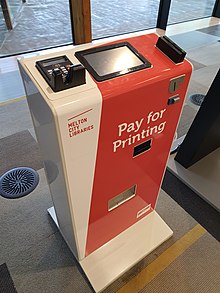
Printing payment self service kiosk
3D press [edit]
3D press is a class of manufacturing engineering science where physical objects are created from three-dimensional digital models using 3D printers. The objects are created by laying downwardly or building up many sparse layers of material in succession. The technique is also known every bit condiment manufacturing, rapid prototyping, or fabricating.[ commendation needed ]
Gang run printing [edit]
Gang run press is a method in which multiple printing projects are placed on a common paper sheet in an attempt to reduce printing costs and paper waste. Gang runs are more often than not used with sheet-fed printing presses and CMYK process color jobs, which require four or eight dissever plates that are hung on the plate cylinder of the press. Printers use the term "gang run" or "gang" to describe the practice of placing many print projects on the same oversized sheet. Basically, instead of running i postcard that is 4 10 6 equally an individual chore the printer would identify 15 unlike postcards on 20 x 18 sheet, therefore using the same amount of press time the printer volition go 15 jobs done in roughly the same amount of fourth dimension every bit one job.
Printed electronics [edit]
Printed electronics is the manufacturing of electronic devices using standard printing processes. Printed electronics technology can be produced on cheap materials such as paper or flexible motion-picture show, which makes it an extremely cost-effective method of production. Since early on 2010, the printable electronics manufacture has been gaining momentum and several large companies, including Bemis Company and Illinois Tool Works have made investments in printed electronics and industry associations including OE-A and FlexTech Alliance are contributing heavily to the advancement of the printed electronics manufacture.[twoscore] [41]
Press terminologies [edit]
Printing terminologies are the specific terms used in the printing industry.
- Airshaft
- Anilox
- Footing weight
- Ben-24-hour interval dots
- Drain (printing)
- Broadsheet
- California Task Case
- Camera-ready
- Carte du jour stock
- Catchword
- CcMmYK colour model
- CMYK color model
- Colophon (publishing)
- Color bleeding (press)
- Composing stick
- Calculator to film
- Computer to plate
- Continuous tone
- Die (philately)
- Dot gain
- Dots per centimeter
- Dots per inch
- Double truck
- Dry transfer
- Dultgen
- Duotone
- Duplex printing
- Edition (printmaking)
- Fault diffusion
- Flong
- Foil stamping
- Page (printing)
- For position merely
- Frisket
- Galley proof
- Gang run press
- Grammage
- Grayness component replacement
- Halftone
- Hand mould
- Hellbox
- Hexachrome
- Hot stamping
- Imposition
- Inkometer
- Iris printer
- Iron-on
- Task Definition Format
- Key plate
- Keyline
- Kodak Proofing Software
- Mezzotint
- Nanotransfer printing
- Non-photo blueish
- Overprinting
- Pagination
- Paste up
- Pre-flight (press)
- Prepress
- Prepress proofing
- Press check (printing)
- Registration black
- Rich black
- Ready-off (printing)
- Spot color
- Stochastic screening
- Transfer-print
- Trap (printing)
- Under color removal
See also [edit]
- Colour printing
- Cloud printing
- Converters (manufacture)
- Dickerson combination press
- Electrotyping
- Flexography
- In-mould decoration
- In-mould labelling
- Jang Yeong-sil
- Laurens Janszoon Coster
- Letterpress printing
- Music engraving
- Music printing
- Impress on demand
- Printed T-shirt
- Printing press bank check
- Security printing
- Cloth printing
- Waterless printing
References [edit]
- ^ Shelagh Vainker in Anne Farrer (ed), "Caves of the Thou Buddhas", 1990, British Museum publications, ISBN 0-7141-1447-2
- ^ a b "Smashing Chinese Inventions". Minnesota-cathay.com. Archived from the original on December 3, 2010. Retrieved July 29, 2010.
- ^ Rees, Fran. Johannes Gutenberg: Inventor of the Printing Printing
- ^ "Oneline Gallery: Sacred Texts". British Library. Archived from the original on November x, 2013. Retrieved March 10, 2012.
- ^ Tsuen-Hsuin, Tsien; Needham, Joseph (1985). Paper and Printing. Science and Civilization in China. Vol. five part one. Cambridge Academy Press. pp. 158, 201.
- ^ Thomas Franklin Carter, The Invention of Printing in China and its Spread Westward, The Ronald Press, NY 2d ed. 1955, pp. 176–78
- ^ Mayor, A Hyatt (1980). Prints and People. Vol. 5–eighteen. Princeton: Metropolitan Museum of Art. ISBN978-0-691-00326-9.
- ^ Richard W. Bulliet (1987), "Medieval Arabic Tarsh: A Forgotten Chapter in the History of Printing". Journal of the American Oriental Society 107 (3), pp. 427–38.
- ^ Meet Geoffrey Roper, Muslim Printing Before Gutenberg and the references cited therein.
- ^ Bloom, Jonathan (2001). Newspaper Earlier Print: The History and Touch of Paper in the Islamic World . New Haven: Yale University Press. pp. viii–10, 42–45. ISBN0-300-08955-4.
- ^ Master Due east.S., Alan Shestack, Philadelphia Museum of Fine art, 1967
- ^ Beckwith, Christopher I., Empires of the Silk Route: A History of Central Eurasia from the Bronze Age to the Present, Princeton University Printing, 2009, ISBN 978-0-691-15034-five
- ^ Tsien 1985, p. 330
- ^ Briggs, Asa and Burke, Peter (2002) However, more correctly it should be described as the other way around. Gutenberg's course of metal movable type was extremely similar to the Korean Jikji's, which was printed 78 years prior to the Gutenberg Bible. A Social History of the Media: from Gutenberg to the Internet, Polity, Cambridge, pp. 15–23, 61–73.
- ^ Steinberg, S. H. (1974). Five Hundred Years of Printing (3rd ed.). Harmondsworth, Middlesex: Penguin. ISBN978-0-14-020343-i.
- ^ Encyclopædia Britannica. Retrieved November 27, 2006, from Encyclopædia Britannica Ultimate Reference Suite DVD – entry "printing"
- ^ Polenz, Peter von. (1991). Deutsche Sprachgeschichte vom Spätmittelalter bis zur Gegenwart: I. Einführung, Grundbegriffe, Deutsch in der frühbürgerlichen Zeit (in German). New York/Berlin: Gruyter, Walter de GmbH.
- ^ In 1997, Fourth dimension–Life magazine picked Gutenberg's invention to be the most important of the second millennium. In 1999, the A&East Network voted Johannes Gutenberg "Man of the Millennium". Run into also ane,000 Years, ane,000 People: Ranking The Men and Women Who Shaped The Millennium Archived October 12, 2007, at the Wayback Machine which was composed by iv prominent US journalists in 1998.
- ^ Pollak, Michael (1972). "The operation of the wooden printing press". The Library Quarterly. 42 (2): 218–64. doi:10.1086/620028. JSTOR 4306163. S2CID 144726990.
- ^ Bolza 1967, p. 80 harvnb mistake: no target: CITEREFBolza1967 (help)
- ^ Bolza 1967, p. 83 harvnb mistake: no target: CITEREFBolza1967 (help)
- ^ Bolza 1967, p. 87 harvnb error: no target: CITEREFBolza1967 (assist)
- ^ a b Bolza 1967, p. 88 harvnb mistake: no target: CITEREFBolza1967 (help)
- ^ Joanna Izdebska; Sabu Thomas (September 24, 2015). Printing on Polymers: Fundamentals and Applications. Elsevier Scientific discipline. p. 199. ISBN978-0-323-37500-9.
- ^ a b Buringh, Eltjo; van Zanden, January Luiten: "Charting the 'Ascent of the West': Manuscripts and Printed Books in Europe, A Long-Term Perspective from the Sixth through Eighteenth Centuries", The Journal of Economical History, Vol. 69, No. 2 (2009), pp. 409–45 (417, tabular array 2)
- ^ a b Ref: Briggs, Asa and Burke, Peter (2002) A Social History of the Media: from Gutenberg to the Cyberspace, Polity, Cambridge, pp. xv–23, 61–73.
- ^ or before long after; Naim A. Güleryüz, Bizans'tan xx. Yüzyıla – Türk Yahudileri, Gözlem Gazetecilik Basın ve Yayın A.Ş., İstanbul, Jan 2012, p. xc ISBN 978-9944-994-54-5
- ^ Watson, William J., "İbrāhīm Müteferriḳa and Turkish Incunabula", Periodical of the American Oriental Society, 1968, volume 88, outcome three, p. 436
- ^ "A Lifetime'due south Collection of Texts in Hebrew, at Sotheby'due south", Edward Rothstein, New York Times, February 11, 2009
- ^ a b Meyrowitz: "Mediating Communication: What Happens?" in "Questioning the Media", p. 41.
- ^ Eisenstein in Briggs and Burke, 2002: p. 21
- ^ a b c d Modie, G (2014). "Gutenberg's Effects on Universities". History of Education. 43 (4): 17. doi:x.1080/0046760X.2014.930186. S2CID 145093891.
- ^ Kipphan, Helmut (2001). Handbook of print media: technologies and production methods (Illustrated ed.). Springer. pp. 130–44. ISBN978-iii-540-67326-2.
- ^ a b c d due east Kipphan, Helmut (2001). Handbook of print media: technologies and product methods (Illustrated ed.). Springer. pp. 976–79. ISBN978-iii-540-67326-2.
- ^ a b Kipphan, Helmut (2001). Handbook of print media: technologies and product methods (Illustrated ed.). Springer. pp. 48–52. ISBN978-three-540-67326-2.
- ^ a b Zeng, Minxiang; Zhang, Yanliang (October 22, 2019). "Colloidal nanoparticle inks for printing functional devices: emerging trends and future prospects". Periodical of Materials Chemistry A. 7 (41): 23301–23336. doi:10.1039/C9TA07552F. ISSN 2050-7496. OSTI 1801277. S2CID 203945576.
- ^ Hu, Guohua; Kang, Joohoon; Ng, Leonard W. T.; Zhu, Xiaoxi; Howe, Richard C. T.; Jones, Christopher Grand.; Hersam, Mark C.; Hasan, Tawfique (May 8, 2018). "Functional inks and press of two-dimensional materials". Chemical Order Reviews. 47 (9): 3265–3300. doi:10.1039/C8CS00084K. ISSN 1460-4744. PMID 29667676.
- ^ Paulsen, Jason A.; Renn, Michael; Christenson, Kurt; Plourde, Richard (Oct 2012). "Printing conformal electronics on 3D structures with Aerosol Jet technology". 2012 Hereafter of Instrumentation International Workshop (FIIW) Proceedings: i–4. doi:ten.1109/FIIW.2012.6378343. ISBN978-i-4673-2482-three. S2CID 21924851.
- ^ "When 2% Leads to a Major Industry Shift Archived February 16, 2008, at the Wayback Machine" Patrick Scaglia, August 30, 2007.
- ^ "Recent Announcements Show Gains Being Made by PE Manufacture". Printed Electronics Now.
- ^ "Printable transistors conductor in 'internet of things'". The Annals . Retrieved September 21, 2012.
Further reading [edit]
- Edwards, Eiluned (December 2015). Block Printed Textiles of India. Niyogi Books. ISBN978-93-85285-03-five.
- Elizabeth 50. Eisenstein, The Printing Press as an Agent of Change, Cambridge Academy Press, September 1980, Paperback, 832 p. ISBN 0-521-29955-1
- Gaskell, Philip (1995). A New Introduction to Bibliography. Winchester and Newcastle: St Paul's Bibliographies and Oak Knoll Press.
- Hargrave, J. (2013). Disruptive Technological History: Papermaking to Digital Printing. Journal of Scholarly Publishing, 44(iii). 221–227.
- Lafontaine, Gerard S. (1958). Lexicon of Terms Used in the Paper, Printing, and Allied Industries. Toronto: H. Smith Paper Mills. 110 p.
- Marshall McLuhan, The Gutenberg Milky way: The Making of Typographic Human (1962) Univ. of Toronto Printing (1st ed.); reissued by Routledge & Kegan Paul ISBN 0-7100-1818-5
- Nesbitt, Alexander (1957). The History and Technique of Lettering. Dover Books.
- Saunders, Gill; Miles, Rosie (May 1, 2006). Prints Now: Directions and Definitions. Victoria and Albert Museum. ISBN978-1-85177-480-seven.
- Steinberg, S.H. (1996). Five Hundred Years of Press. London and Newcastle: The British Library and Oak Knoll Printing.
- Tam, Pui-Wing The New Newspaper Trail, The Wall Street Periodical Online, February 13, 2006 p. R8
- Tsien, Tsuen-Hsuin (1985). "Paper and Press". Joseph Needham, Science and Civilisation in China, Chemistry and Chemical Technology. 5 function 1. Cambridge University Press.
- Woong-Jin-Wee-In-Jun-Gi No. 11 Jang Young Sil past Baek Sauk Gi. 1987 Woongjin Publishing Co., Ltd. p. 61.
On the effects of Gutenberg's printing
Early printers manuals [edit]
The classic manual of early hand-press engineering science is
- Moxon, Joseph (1962) [1683–1684]. Herbert, Davies; Carter, Harry (eds.). "Mechanick Exercises on the Whole Art of Printing" (reprint ed.). New York: Dover Publications.
- A somewhat later one, showing 18th century developments is
- Stower, Caleb (1965) [1808]. "The Printer'south Grammar" (reprint ed.). London: Gregg Press.
External links [edit]
 | Wait up printing in Wiktionary, the free lexicon. |
 | Wikiquote has quotations related to: Printing |
 | Wikimedia Commons has media related to Printing. |
- . Encyclopædia Britannica. Vol. 22 (11th ed.). 1911.
- . New International Encyclopedia. 1905.
- Prints & People: A Social History of Printed Pictures, an exhibition itemize from The Metropolitan Museum of Art (fully available online as PDF)
- Eye for the History of the Book
- Printing Industries of the Americas – trade association for printers and companies in the graphic arts
- The evolution of book and printing. English website of the Gutenberg-Museum Mainz (Germany)
- BPSnet British Press Club
- Taiwan Culture Portal: Ri Xing Type Foundry – preserving the true graphic symbol of Chinese type
- A collection of printing materials from the 19th Century – Documents printed by R. Mathison Jr., The Job Printer, in Vancouver, B.C. – UBC Library Digital Collections
- International Printing Museum, Carson, CA, Web site
- Museum of Printing, Andover, MA, Spider web site
- American Printing History Association, NY, Spider web site
- Hamilton Woods Type and Printing Museum, WI, Web site
- History of Printing – Timeline
DOWNLOAD HERE
Posted by: pettythadvating.blogspot.com


0 Komentar
Post a Comment